
Red Kitchen
Red Kitchen is G3N’s full-scale Mars analog and extreme-environment testing facility, designed to develop and validate the hardware, software, and infrastructure required for autonomous machines to operate on Mars.
The facility combines Mars terrain simulation, environmental chambers, robotic test ranges, habitat systems, and mission-control infrastructure into one integrated development environment.
Mars Terrain
A large-scale outdoor test range recreates key Martian surface conditions using engineered regolith simulants, basaltic rocks, loose soil, slopes, trenches, craters, and irregular terrain.
G3N robots are tested for:
* Locomotion and traction
* Autonomous navigation
* Terrain classification
* Manipulation and object recovery
* Excavation and drilling
* Payload transport
* Autonomous construction
Extreme Environment Testing
Controlled chambers reproduce selected environmental parameters relevant to Mars, including:
* Low atmospheric pressure
* CO₂-dominant atmosphere
* Extreme thermal cycling
* High dust loading
* Reduced visibility
* Vacuum and thermal-vacuum conditions
* Radiation exposure testing
These environments are used to characterize batteries, motors, actuators, electronics, sensors, seals, thermal-management systems, materials, and robotic skins..
Habitat & Infrastructure
A full-scale Mars habitat zone allows G3N robots to operate inside a connected infrastructure system.
Robots must inspect, maintain, repair, transport, construct, and operate:
* Habitats
* Power systems
* Solar arrays
* Communications equipment
* Water systems
* Storage systems
* Workshops
* Scientific equipment
The objective is simple: build machines on Earth that are ready to work on Mars.
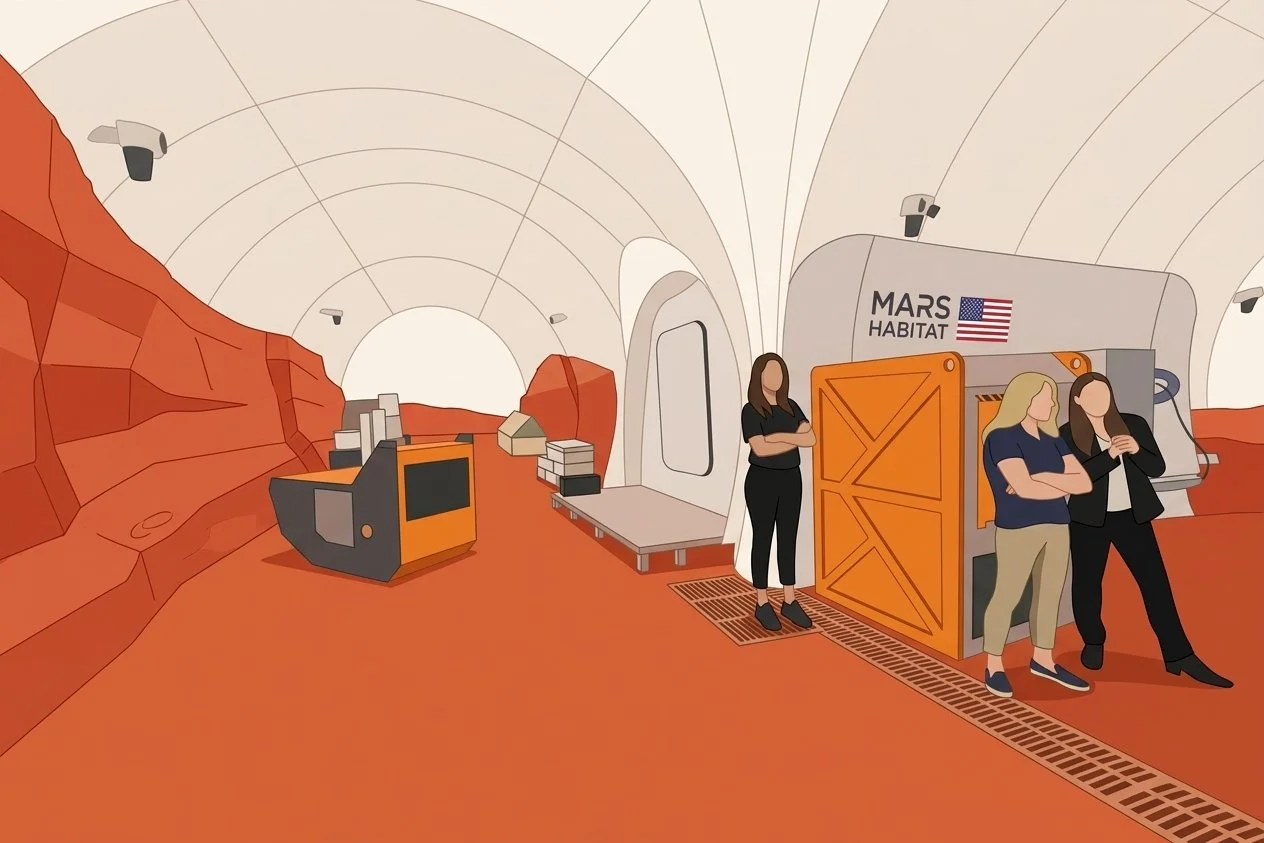
NASA unveils new Mars habitat simulation on Earth